Technology Readiness Levels (TRLs) and How They Fit with IDC’s Process
Technology Readiness Levels (TRLs) are a scale from 1 to 9 used to measure how mature a technology is. They are widely used in academia and venture capital but in many areas of industry they rarely feature and are little understood. The TRL framework offers a useful framework and common language to help organisations to assess technological risk, plan investments, and communicate progress between engineering, management, and finance, linking technical milestones with business decision-making. If you are applying for grant funding such as UKRI, Horizon Europe, Innovate UK, you may need to ensure the funding call matches your current and target Technology Readiness Level and explain how the project will move the development up the scale.
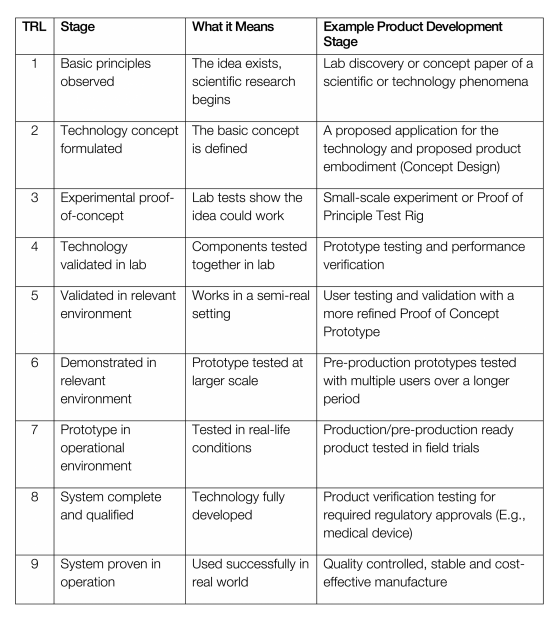
The concept of TRLs was originally developed by NASA to provide a consistent framework for assessing the maturity of a technology as it moves from idea to real-world application. As a product design consultancy, IDC works with start-ups, SMEs and large companies at all TRL stages but with a big focus on the end goal of getting a commercial product on the market. This can involve helping companies move from first idea (TRL1) through to successful commercially available products (TRL9). The table below provides a summary of the different Technology Readiness Levels and examples within a typical new product development process.
In reality, developing innovative new products doesn’t always involve all the TRL stages. Many innovations come from the application of existing, well-proven technology (TRL 4 or 5) to a new application or a significant user or performance improvement for product. In many cases it is possible for one phase of work to rapidly take the development up several technology readiness levels. In general, the levels can be summarised as:
- TRL 1–3: Ideas and research
- TRL 4–6: Engineering, prototyping, testing and refinement
- TRL 7–9: Demonstration, production scale up and launch
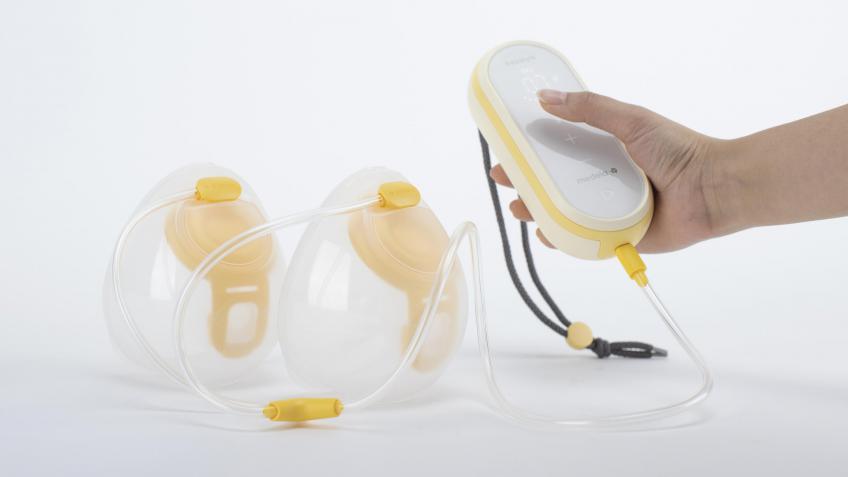
Example 1: Medela Freestyle™ Hands-Free Breast Pump (TRL5-TRL9)
Hands-free breast pumps were already existing when Medela approached IDC to design a wearable breast pump with improved performance, comfort and convenience. The IDC development programme took the product development from TRL 5 where the general technology was proven but not in the configuration needed for maximum user convenience through to TRL 9 as a fully approved and commercial product in production.
Read the full case study here: https://www.idc.uk.com/consumer/case-studies/wearable-breast-pump/
Example 2: Ori Biotech (TRL1-TRL5)
Ori Biotech approached IDC with an idea for an advanced improved and cost-effective bioreactor for growing CAR-T cells for advanced cancer treatment. Ori had developed a laboratory process to culture the cells and wanted to make an automated bioreactor with a fully sterile, low-cost consumable. IDC took the idea from TRL1 where it was just an idea to TRL5 – a representative, fully working machine and sterile consumable that allowed the cell culturing performance to be independently verified. This enabled Ori to get significant venture capital investment and build up their internal team.
How IDC Supports Companies Through the TRL Journey
At IDC, we help organisations navigate the entire TRL spectrum from initial feasibility studies through to production-ready systems. Our process combines engineering rigour, user insight, and design for manufacture to maximise the chance of getting to a commercially successful product.
We use a four-stage process; EXPLORE, CREATE, DEFINE and DELIVER and we use this as a framework to create a bespoke programme of activities for every project. Here’s how the IDC process fits with Technology Readiness Levels.
EXPLORE: Early-Stage Definition (TRL 1-2)
The EXPLORE stage is where our multidisciplinary teams conduct technology scoping, patent research, feasibility studies and user research to turn early ideas into clearly defined, evidence-based propositions. Using tools such as the Product Requirement Specification (PRS) and risk mapping, to give an honest and detailed assessment of the opportunity and risks, we help clients establish a solid foundation for investment and development. This can sometimes lead to plans being altered or shelved to ensure the investment is only made if the product has a high likelihood of success.
CREATE: Applied Research & Prototyping (TRL 3-4)
The CREATE stage sets the vision and direction for the product. Proof of principal test rigs prove out the technology and product engineering at the functional heart of the product. These prototypes get iterated and improved until the reliability and performance is confirmed. At the same time the industrial design vision for the product is developed, combining the technology underpinnings with the user requirements. These concepts and prototypes are often validated with users to get early feedback and build confidence.
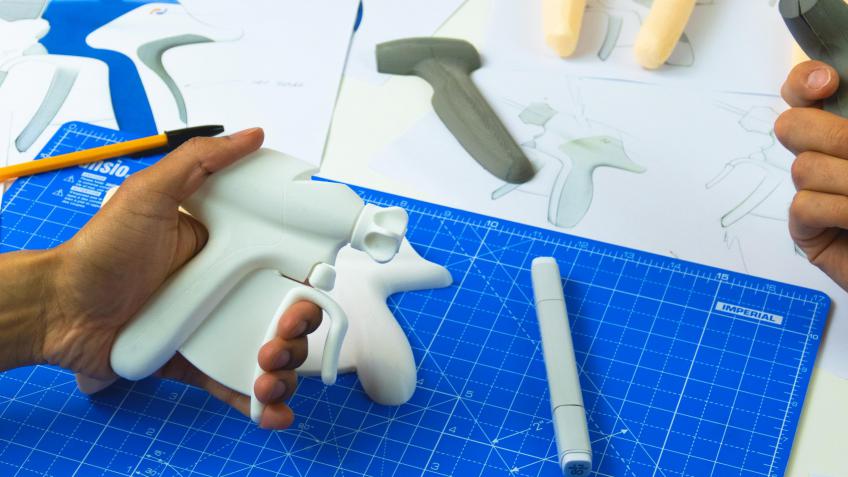
DEFINE: Engineering Development & Prototyping (TRL 5-7)
The DEFINE stage is where the detailed mechanical and electronic design for manufacture and assembly (DFMA) happens and all the product details are defined. Where applicable embedded software is also written and prototypes of the design are made and tested to refine the production design. Several prototypes can be made and iterated but where possible we try to rapidly get to a pre-production prototype allowing for testing, verification and transfer to manufacturing at the end of the DEFINE stage
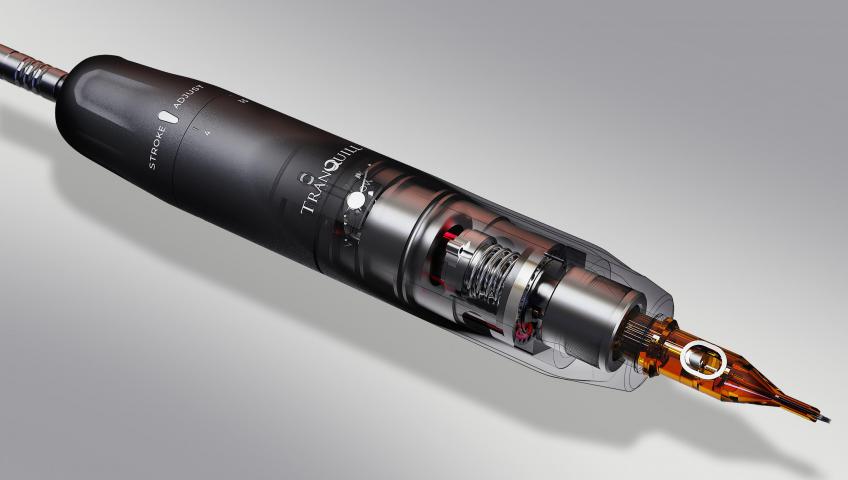
DELIVER: Pre-Production & Certification (TRL 8-9)
The DELIVER stage covers everything that happens between making a prototype that meets the general performance requirement and getting the product onto the market. For a regulated product like a medical or diagnostic device this means getting regulatory approval. At IDC our ISO9001 and ISO13485 certified processes support clients through transfer to manufacturing and final verification and approvals, including providing the documentation required for regulatory submission. Over 91% of our work results in the product successfully reaching the market.
Key Takeaways:
- TRL levels are used for grant funding by bodies such as UKRI, Horizon Europe and Innovate UK
- Technology Readiness Levels are an important measure for technology investors
- Not every product development needs to follow the TRL process rigidly
- Plan your development stages based upon risk, cost and complexity - sometimes it is better to design a good first prototype to get real world learnings quickly
- Be clear about what you are trying to achieve – a good product specification can save a lot of wasted effort
About the Author
Stephen Knowles is the Managing Director of IDC. A chartered engineer with 25+ years experience leading technical and non-technical product developments in the medical industry. With a PhD in Mechanical Engineering and a thorough understanding of design and manufacture, Stephen is often invited to speak on the subject of product development. Contact: stephen.knowles@idc.uk.com

Sign up for our top resources on product design and development