What is Circular Product Design?
Most products follow the same trajectory: materials are extracted, a product is manufactured, it gets used, and then it gets thrown away. This linear model - take, make, dispose - has defined industrial production for over a century.
Circular product design challenges it directly. Rather than designing a product for a single life that ends in landfill, circular product design builds end-of-life thinking into the beginning of the design process.
What happens to this product when a user is done with it? Can it be repaired, disassembled, reused, or returned to the material supply chain? These questions, raised early enough, fundamentally change how a product is engineered. The gap between intention and execution is where most circular design efforts fall down.
Passable sustainability statements are easy.
Products that are genuinely designed to close the loop are considerably harder, and require a different set of decisions at every stage of development.
How Circular Product Design Differs From Traditional Development
In conventional product development, environmental impact is often considered late: a compliance consideration, a materials swap, or an eco-labelling exercise applied to a design that was fundamentally conceived around cost and function. Circular product design moves that thinking upstream, so that the structure, materials, and system around a product are shaped by circularity from the outset.
The distinction matters in practice:
a product designed for disassembly requires different joining methods, component hierarchies, and material choices than one designed purely for assembly efficiency.
a product designed for repair requires accessible components, available parts, and documentation.
a product designed for reuse requires durability standards and a system to support collection, cleaning, and redistribution.
None of these can be retrofitted convincingly after the design is complete.
Circular product design also operates at a system level that traditional development rarely reaches. The product itself is only part of the picture: the supply chain, the use model, the end-of-life infrastructure, and the business model all interact with the physical design to determine whether circularity is real or theoretical.
The Principles That Define Circular Product Design
Design for longevity
The most circular product is often the one that doesn't need to be replaced. Material selection, structural engineering, surface treatment, and component quality all influence how long a product remains functional. Designing for durability is not in tension with good commercial design - products that last build brand trust and reduce the total cost of ownership for users.
Design for repair and maintenance
A product that cannot be economically repaired will be replaced. Repairability requires accessible fasteners, replaceable wear components, clear service documentation, and a supply chain that supports parts availability over time. These decisions are made in the detailed engineering phase, and reversing them retrospectively is expensive.
Design for disassembly
At end-of-life, a product's material value depends almost entirely on whether its constituent materials can be separated cleanly. Mixed-material assemblies, adhesive bonding, and overmoulding all complicate disassembly and reduce recyclability. Designing for disassembly means understanding the end-of-life processing infrastructure that will handle the product, and engineering accordingly.
Material selection and traceability
The choice of material is one of the most consequential decisions in circular product design. Bio-based materials, recycled content, and materials with established closed-loop recycling streams all carry different implications for environmental impact and end-of-life value. Increasingly, traceability - knowing where a material came from and being able to verify its provenance - is becoming a commercial and regulatory expectation, not just an ethical preference.
Modularity and upgradability
Products designed in modules can be partially replaced, upgraded, or repurposed rather than entirely replaced. This is particularly relevant for electronics and complex consumer products where one component becomes obsolete while the rest of the product remains functional. Modularity requires early architectural decisions that cannot easily be added later.
Reuse systems and product-as-a-service models
For some product categories, the most effective circular model involves the manufacturer retaining ownership of the product and selling access or outcomes rather than units. This changes the economics of durability dramatically - a manufacturer who takes back their product at end-of-life has a direct financial incentive to design it to last and to be easily refurbished. Designing for reuse systems requires the physical product and the business model to be developed together.
Circular Product Design in Practice: The Reuser Coffee Cup
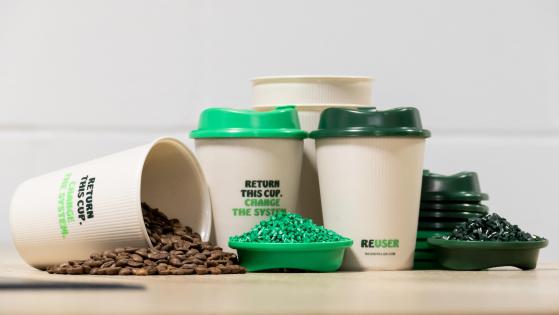
Circular principles work differently across product categories, and the decisions involved are rarely simple. Our Reuser Project illustrates what genuine circular product design looks like when it is taken seriously from the start.
Reuser developed a reusable coffee cup system aimed at replacing single-use disposable cups in coffee shops and restaurants, with a collection, cleaning, and redistribution infrastructure built around the physical product. At this point, we were brought in to design and develop the cup lids, with circularity as a core requirement rather than an optional feature.
The material challenge was significant. Standard polypropylene was off the table - Reuser's mandate required renewable feedstocks. Working with Naiad Plastics, IDC's UK injection moulding partner, the team developed lids using 'Bornewables' Bio-PP: a plant-based polypropylene derived from renewable vegetable oil feedstock, fully traceable to point of origin and ISCC PLUS certified. Naiad became the first UK manufacturer to use this material within the food and drink industry.
This was not a straightforward material substitution. Bio-PP processes differently from conventional polypropylene, and the tooling, pre-production runs, and fine-tuning required to achieve consistent quality at production scale demanded significant engineering effort. The team took the project from initial design through to full production in six months, covering concept generation, rapid prototyping, bio-polymer research, material lifecycle review, detailed design for manufacture, tooling, and production support.
The result is a lid that supports a genuinely circular system: designed for repeated use, made from renewable and traceable materials, and manufactured within a supply chain that was built to sustain the circular model rather than undermine it. As Andrew Matthews, founder of Reuser, noted: the commercial viability of their mission depended on the engineering and production capability behind the physical product, not just the sustainability ambition in front of it.
The honest answer is that circular product design involves real trade-offs, and organisations that present it otherwise are usually describing circularity in marketing terms rather than engineering ones. Bio-based and recycled materials frequently carry cost premiums and processing challenges compared to virgin conventional materials. Designing for disassembly can add cost and complexity to assembly. Modular architectures can increase component count and unit cost. Reuse systems require operational infrastructure (collection, cleaning, logistics, quality control) that adds cost and complexity well beyond the product itself. These trade-offs are manageable, but they require honest assessment early in development when design decisions still have the flexibility to address them. The organisations that make circular product design work commercially are those that integrate sustainability requirements into the brief from day one, rather than attempting to apply them to a design conceived around other priorities. Regulatory pressure is also accelerating the pace of change. The EU's Ecodesign for Sustainable Products Regulation (ESPR) is extending mandatory circularity requirements across an expanding range of product categories. Extended Producer Responsibility (EPR) schemes are making end-of-life management a financial reality for manufacturers rather than an abstract commitment. The commercial case for investing in circular design is strengthening whether organisations choose to lead or are required to follow. Circular product design does not fit neatly into a conventional development process that treats sustainability as a late-stage consideration. It requires specific capabilities at specific points. Early in development, it requires life cycle thinking: an understanding of where environmental impact accumulates across extraction, manufacture, use, and end-of-life — to inform material and architectural decisions before they become fixed. It requires knowledge of emerging materials, their processing behaviour, and their supply chains, because sustainable material options are developing rapidly and the performance envelope of bio-based and recycled alternatives is expanding. Through detailed design, it requires engineering for the specific requirements of circular outcomes: tolerances and surface finishes suited to reuse, joining methods compatible with disassembly, component architectures that support repair. And it requires a supply chain that can actually deliver on the material and process commitments made in the design - as the Reuser project demonstrated, the manufacturing partner is as much a part of the circular system as the product itself. Our sustainable design resources cover the frameworks, materials, and methodologies that inform this kind of development work, for teams at any stage of their circular design journey. Circular product design reflects a broader shift in how the relationship between products and resources is understood. The linear model treats materials as inputs to be consumed. The circular model treats them as assets to be preserved - their value maintained through reuse, repair, remanufacturing, and ultimately material recovery. For product development teams, this shift is most tangible in the questions that need to be answered at the beginning of a project rather than the end: Who will collect this product? How will it be cleaned, tested, or refurbished? What happens to it if it cannot be reused? Which materials retain their value through multiple life cycles, and how do we specify them in a way that preserves that value? These are design questions. The answers to them determine whether a product's sustainability credentials hold up under scrutiny, or whether they are simply what the packaging says. Where Circular Product Design Gets Difficult
What Circular Product Design Requires of the Development Process
The Broader Shift Circular Product Design Represents

About the Author
Stephen Knowles is the Managing Director of IDC. A chartered engineer with 25+ years experience leading technical and non-technical product developments in the medical industry. With a PhD in Mechanical Engineering and a thorough understanding of design and manufacture, Stephen is often invited to speak on the subject of product development. Contact: stephen.knowles@idc.uk.com