Rapid Prototyping Methods & Technologies: Our Approach
A common question for clients when looking at design processes is what is rapid prototyping?
The most straightforward answer is: it’s the discipline of learning quickly through creation, before making improved decisions because based on the tangible realities of a product. Design intent is either confirmed or challenged by reality. Assumptions are exposed, and development accelerates.
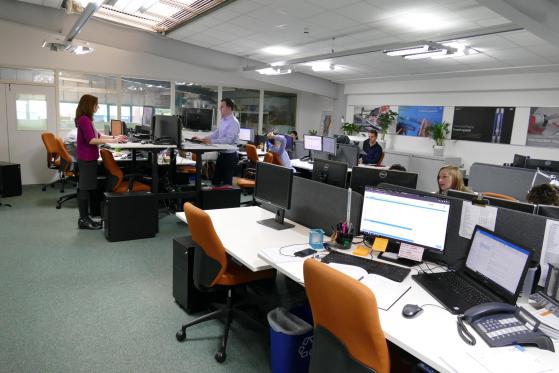
Our in-house prototyping capabilities are central to how we can develop products and stronger outcomes with earlier risk reduction across our projects. Much of this work is delivered through our dedicated prototyping and manufacturing services, where design, engineering, testing and prototyping exist side by side.
What Rapid Prototyping Actually Delivers
At its core, rapid prototyping compresses learning.
It allows teams to move from assumption to evidence in days rather than months, replacing debate with data and opinion with observation.
Early prototypes reveal ergonomic issues, assembly challenges, tolerance conflicts and usability risks that rarely appear in CAD alone. Later prototypes allow performance, durability and manufacturing assumptions to be tested under realistic conditions. Together, they form a continuous feedback loop that stabilises design direction long before production tooling is committed.
This is why rapid prototyping remains, and will remain, one of the most powerful risk management tools in modern product development.
3D Printing as a Design Accelerator
Additive manufacturing is one of the fastest ways to move from concept to physical evaluation. Our team use multiple 3D printing technologies, depending on what needs to be learned at each stage:
FDM supports early form exploration and ergonomic studies.
SLA delivers high-resolution surfaces for detailed interface evaluation.
SLS enables stronger functional components suitable for mechanical testing and early assembly trials.
Material choice is critical. Rigid plastics, elastomers and filled polymers each reveal different aspects of performance, allowing us to simulate how production materials may behave before committing to tooling. This flexibility enables rapid iteration without sacrificing technical insight.
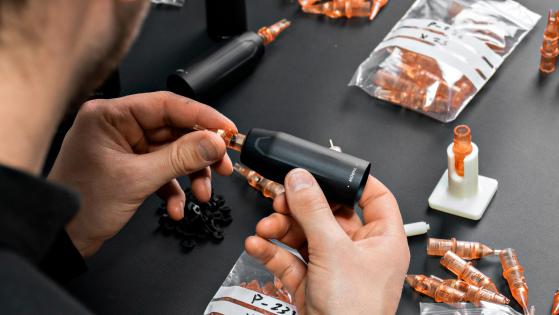
When accuracy and mechanical performance become central to evaluation, CNC machining becomes the primary prototyping route. Machined prototypes allow true representation of final tolerances and structural behaviour. They support early verification of load paths, thermal behaviour and interface precision. For regulated products, this level of fidelity is often essential long before validation stages begin. CNC prototypes also allow teams to evaluate manufacturability while design freedom still exists. Tool access and process constraints are uncovered early, preventing costly redesign later. Vacuum casting sits between prototyping and production. It provides low-volume parts with material properties and surface finishes that closely replicate injection moulded components, making it invaluable for: Pilot builds User trials Pre-production testing We use vacuum casting when the focus shifts from pure design learning toward market readiness. It allows products to be evaluated in real-world conditions while maintaining the flexibility to refine design before tooling investment.CNC Machining for Functional Validation
Vacuum Casting for Production - Representative Parts
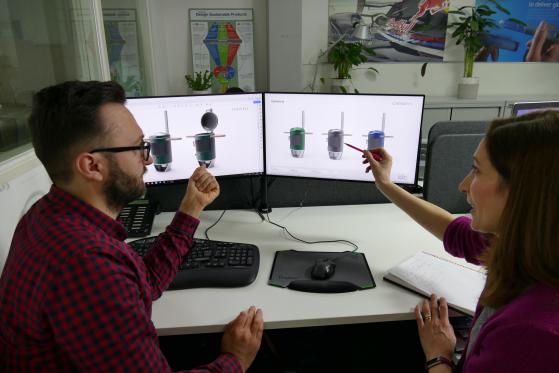
SLA and SLS technologies support different objectives within rapid prototyping. SLA Excels when fine detail, transparency or surface quality are critical. It is particularly effective for optical components and interface elements where visual and tactile performance must be evaluated. SLS Offers strength and thermal stability, enabling prototypes to withstand mechanical loading and extended testing cycles. These properties make it ideal for functional housings, structural components and complex assemblies. Rapid prototyping becomes most effective when it is embedded into a structured development workflow: Concept models inform early architecture and layout decisions. Functional prototypes validate performance and integration. Pre-production builds confirm manufacturability, usability and reliability. Each phase reduces uncertainty and increases confidence. By the time a design approaches tooling, most critical risks have already been identified and resolved.SLA and SLS for Precision and Strength
Prototyping Workflows To Reduce Risk
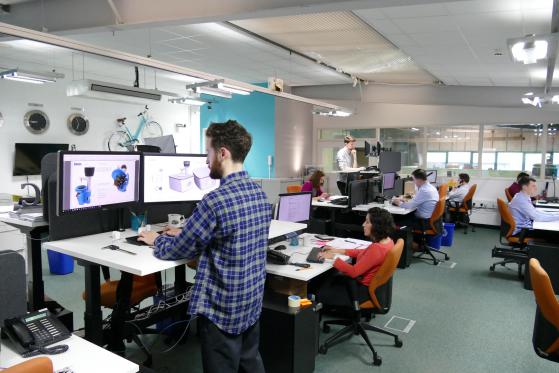
Prototyping without testing is just decoration. Does the user understand the interface? Does the mechanism survive load? Does the assembly behave as expected? Does the material degrade under heat or chemical exposure? Test results drive iteration. Each cycle strengthens the design, refining geometry, materials and interaction until performance and manufacturability converge. Over time, the product evolves from concept into a stable, production-ready system supported by evidence rather than assumption. When learning happens early and continuously, development becomes more predictable and far less expensive. Problems surface when they are still solvable and opportunities appear while design freedom remains high. That is why rapid prototyping remains one of the foundations of how we develop products at IDC. Explore our Prototyping Services further or get in touch to see how we can bring your next product to life.Testing, Iteration and Material Learning
Every model exists to answer specific questions:Why Rapid Prototyping Remains Central to Our Approach

About the Author
Stephen Knowles is the Managing Director of IDC. A chartered engineer with 25+ years experience leading technical and non-technical product developments in the medical industry. With a PhD in Mechanical Engineering and a thorough understanding of design and manufacture, Stephen is often invited to speak on the subject of product development. Contact: stephen.knowles@idc.uk.com